Not Just Teaching — Teachers as Leaders
1.0 Introduction
The role of teachers has always extended beyond the classroom, but over the years it has become increasingly multi-faceted. Historically, teachers were primarily viewed as transmitters of knowledge — responsible for delivering subject content and ensuring students met academic standards (Darling-Hammond, 2017). Today, however, the expectations of teachers have broadened significantly. Teachers are now expected to nurture holistic student development, cultivate critical thinking, foster creativity, and guide learners to thrive in an interconnected and fast-changing world. In addition to imparting knowledge, they play roles as mentors, role models, community builders, and even change agents within the education system.
In this evolving context, leadership has become an indispensable component of effective teaching. Teachers, especially in underserved communities, are not just tasked with managing classrooms but with inspiring students to envision possibilities beyond their current realities. They must demonstrate resilience, empathy, adaptability, and problem-solving while motivating learners to persist in the face of challenges. Leadership in teaching therefore goes beyond authority; it embodies influence, vision, and the ability to mobilize young people toward a brighter future.
For this reason, Lead For Ghana anchors its training model for Associates on a leadership-centered framework. Associates are equipped with 16 core competencies that not only enhance their teaching practice but also strengthen their capacity to serve as leaders in their classrooms and communities. By emphasizing leadership, we reaffirm the belief that teachers are among the most powerful catalysts for societal transformation. This month’s insight is particularly timely, as August marks the recruitment and intensive training of a new cohort of Associates preparing for deployment to underserved communities. Inspired by this moment, we asked respondents — including both new and continuing Associates — to reflect on the 16 core competencies and select the top five they consider most essential for teachers to be effective leaders in their dual roles — as educators and as leaders.
2.0 Findings
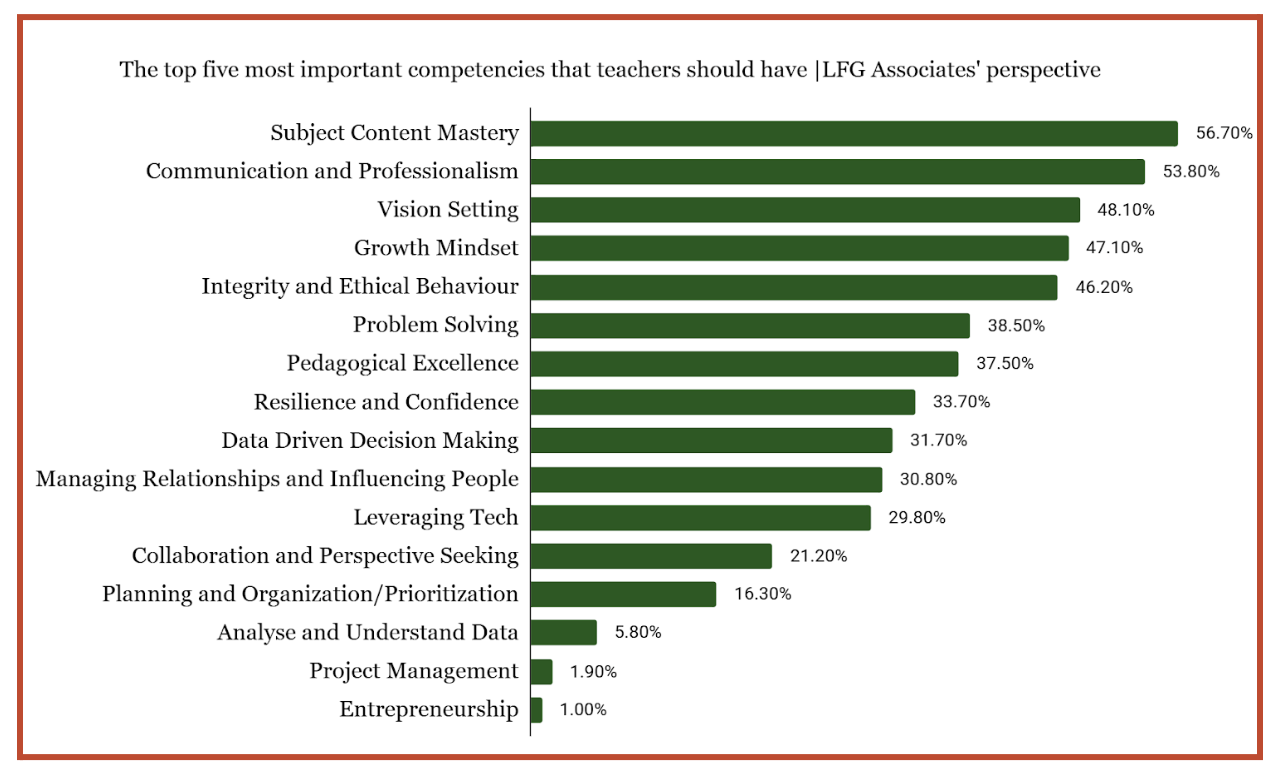
The survey asked Associates to select the five most important competencies they believe teachers should have to be effective leaders. The responses highlighted the following top five, in order of prominence: Subject Content Mastery (56.7%), Communication and Professionalism (53.8%), Vision Setting (48.1%), Growth Mindset (47.1%), and Integrity and Ethical Behaviour (46.2%).
Respondents placed subject mastery as the topmost competence a teacher should have, reflecting the belief that effective teaching starts with strong content knowledge (Ansah et al., 2020). In underserved contexts, where students have limited access to supplementary learning resources, a teacher’s mastery directly determines the quality of education learners receive. This mastery is often demonstrated through the teacher’s leadership role, which inspires students to learn (Lovett, 2023). Brunetti et al. (2023) however found that teachers’ content knowledge is often inadequate in developing countries such as Ghana, with many mastering less than half of the curriculum they are expected to deliver. While professional development programs such as computer-assisted learning and workshops can strengthen mastery, the study revealed that such gains depreciate significantly over time. This demonstrates how deficits in content knowledge constrain instruction and weaken student learning, emphasizing the need for continuous and sustainable investment in teacher professional growth.
Communication and professionalism followed closely, emphasizing the teacher’s role as a role model whose conduct and clarity of expression build trust with students, parents, and communities. As Muste (2016) notes, effective communication in education depends on the teacher’s ability to clearly and confidently express ideas while adapting style to foster positive interactions with students, which builds learners’ confidence and gives them a sense of direction in approaching complex challenges in education and beyond. Similarly, Majid (2017) emphasizes that teachers’ interpersonal communication skills—such as speaking, classroom control, and fostering caring relationships—are crucial for enhancing students’ social development and the overall quality of teaching. Teachers with good communication skills and professionalism will create a more successful teaching and learning ambience for the students. On the other hand, when students perceive teacher communication negatively, it leads to emotional exhaustion, which undermines their learning experience and reduces overall achievement (Wu, 2025).
Vision setting ranked the third competence, with respondents highlighting the importance of teachers inspiring students with clear goals and aspirations beyond immediate academic tasks. Teachers with inaccurately low expectations of their students have been shown to undermine learning, as lower expectations are associated with lower student achievement (Gentrup et al., 2020). Similarly, Rubie-Davies and Hattie (2024) note that low-expectation teachers often fail to set meaningful goals, rely on repetitive tasks, and create less engaging classroom environments — resulting in diminished student motivation, engagement, and achievement. Teacher visioning however can help translate educational theories into effective classroom practices, enabling teachers to set clear goals that inspire students beyond immediate academic tasks (Vaughn et al., 2021).
Growth mindset came next, underscoring the belief that teachers who demonstrate perseverance and model continuous improvement instill resilience in their learners. Supporting this, He, Iskhar, Yang, and Aisuluu (2023) highlight that cultivating a growth mindset, alongside mindfulness and grit, is vital not only for student outcomes but also for teacher well-being, with important implications for training and support programs. Similarly, Rissanen et al. (2021), in a case study of Finnish teachers, found that implementing Growth Mindset Pedagogy (GMP) enabled teachers to help students regulate emotions and normalize struggle—though they cautioned that superficial or tokenistic applications risk undermining its effectiveness. In contrast, studies show that fixed-mindset orientations among teachers can be harmful. Heyder and Pegels (2025) found that teachers who express fixed beliefs elicit more negative emotions, higher stress expectations, lower motivation, and reduced help-seeking among students; Wang et al. (2024) similarly reported that teachers with stronger fixed-mindset views demonstrate less supportive practices and contribute to lower student well-being, whereas teacher growth mindset was positively correlated with student wellbeing. Likewise, de Vocht et al. (2024) demonstrated that in teacher-focused mindset programs, those with more fixed beliefs were less likely to engage meaningfully, resulting in reduced programme impact on both their own well-being and their students’ learning.
Finally, integrity and ethical behaviour were seen as critical, especially in communities where teachers serve as moral examples. Supporting this, Jan and Iqbal (2021) found that teacher educators widely agreed on the importance of professional conduct and ethics, and their study revealed a statistically significant positive relationship between perceptions of ethical practice and students’ academic performance. Furthermore, Nasir, Awaluddin, and Ashar (2024) demonstrated that explicit ethics training improves teachers’ decision-making in dilemmas related to discipline, equity, and privacy, which in turn strengthens teacher–student relationships and promotes fairness in the classroom. On the other hand, studies on building academic-integrity cultures show that weak policies and staff non-compliance act as barriers; when teachers behave unethically, the entire school climate deteriorates (Çelik & Razı, 2023). These findings underscore that when teachers model integrity and ethical behaviour, they not only build trust within their communities but also directly contribute to student success.
In the current dispensation, where the world is increasingly driven by technology and data, one might have expected competencies such as data-driven decision-making, analyzing and understanding data, and leveraging technology to appear among the top five. Interestingly, while these competencies were included in the broader list, the respondents did not rank them among their most essential five as required by the research. This outcome suggests that the respondents currently place stronger emphasis on more traditional competencies — such as subject mastery, communication, vision-setting, growth mindset, and integrity — when they think about teacher-leadership. It may also reflect the extent to which respondents feel less equipped or less immediately resourced to prioritize technology integration and data use in their teaching practice.
While our findings are specific to Associates, they raise an important point for consideration in the broader Ghanaian education context: if teachers are not confident or trained in leveraging data and technology, decisions in classrooms may remain largely intuitive rather than evidence-based. This, in turn, could limit the extent to which student progress is systematically tracked, learning gaps are identified, and timely interventions are designed. At the systemic level, Ghana risks widening the gap with countries that are leveraging data and technology to accelerate educational transformation. This challenge is not only a barrier to local progress but also projects Ghana as lagging behind in aligning its educational practices with global standards.
For Associates — and potentially for teachers more broadly — addressing this gap requires intentional investment in professional development focused on digital literacy, data-driven decision-making, and educational technology. Doing so would not only strengthen their classroom leadership but also better prepare Ghana’s learners for the demands of a rapidly evolving, technology-driven global economy.
3.0 Conclusion
Teachers are not only transmitters of knowledge but also leaders who shape the character, aspirations, and resilience of the next generation. Their leadership is reflected in their ability to set a vision, communicate effectively, uphold integrity, demonstrate subject and pedagogical mastery, leverage technology, make data driven decisions, and inspire growth mindsets in their learners. In this way, teachers are uniquely positioned as agents of transformation in both classrooms and communities.
Developing such leadership, however, requires intentional investment. For new teachers, early induction and structured mentoring are critical in building the confidence and competencies necessary for leadership. Existing teachers benefit from continuous professional development that deepens subject knowledge while strengthening ethical practice, resilience, and innovation. School heads also play a vital role by modeling leadership, fostering collaborative cultures, and creating enabling environments where teachers can grow as leaders. Leadership is therefore not an individual pursuit but a collective responsibility across the education ecosystem.
At the heart of this effort is Lead For Ghana’s two-year Fellowship model, which serves as a transformative platform for developing leadership in teachers. Through the Fellowship, Associates are equipped with core competencies that go beyond classroom instruction, preparing them to navigate complex challenges, mobilize communities, and drive systemic change. The impact is evident: Fellows emerge not only as effective teachers but also as ethical leaders committed to shaping a more equitable future for Ghana. By embedding leadership development into the very fabric of teacher preparation, Lead For Ghana affirms that teachers are—and must continue to be—leaders of change.
4.0 Reference
Abdul Majid, Norliza. (2017). The Importance of Teachers' Interpersonal Communication Skills in Enhancing the Quality of Teaching and Learning. World Applied Sciences Journal. 35. 924-929. 10.5829/idosi.wasj.2017.924.929.
Ansah, Joseph & Mensah, Natalia & Wilmot, Eric. (2020). Influence of Subject Matter Knowledge on Students’ Elective Mathematics Performance in Senior High Schools in Ghana: Does Teaching Experience Matter?. American Journal of Education and Learning. 5. 87-95. 10.20448/804.5.1.87.95.
Brunetti, A., Büchel, K., Jakob, M., Jann, B., & Steffen, D. (2023). Inadequate teacher content knowledge and what could be done about it: evidence from El Salvador. Journal of Development Effectiveness, 16(2), 206–229. https://doi.org/10.1080/19439342.2023.2213681
Çelik, Ö., & Razı, S. (2023). Facilitators and barriers to creating a culture of academic integrity at secondary schools: An exploratory case study. International Journal for Educational Integrity, 19(1), 4. https://doi.org/10.1007/s40979-023-00125-4
Darling-Hammond, L. (2017). Teacher education around the world: What can we learn from international practice? European Journal of Teacher Education, 40(3), 291–309. https://doi.org/10.1080/02619768.2017.1315399
de Vocht, F., Garay, S., Reed, H., Small, G., Barrett, A., Murphy, S., & Morgan, K. (2024). Impacts of the Mindset Teams Programme on Teacher Outcomes and Pupil Educational Attainment: Secondary Data Analysis. Journal of Research on Educational Effectiveness, 1–17. https://doi.org/10.1080/19345747.2024.2403989
Gentrup, S., Lorenz, G., Kristen, C., & Kogan, I. (2020). Self-fulfilling prophecies in the classroom: Teacher expectations, teacher feedback and student achievement. Learning and Instruction, 66, 101296. https://doi.org/10.1016/j.learninstruc.2019.101296
He, J., Iskhar, S., Yang, Y., & Aisuluu, M. (2023). Exploring the relationship between teacher growth mindset, grit, mindfulness, and EFL teachers' well-being. Frontiers in psychology, 14, 1241335. https://doi.org/10.3389/fpsyg.2023.1241335
Heyder, A., & Pegels, H. (2025). Detrimental effects of instructors’ fixed mindsets on students’ anticipated motivation and emotions in secondary and higher education. Social Psychology of Education, 28, 32. https://doi.org/10.1007/s11218-024-10001-9
Jan, Shahida & Iqbal, Zafar. (2021). Perception of Teacher Educators about Professional Conduct and Ethics and its Impact on Students' Academic Performance. Global Sociological Review. VI. 113-120. 10.31703/gsr.2021(VI-II).14.
Moraal, E., Suhre, C., & van Veen, K. (2024). The importance of an explicit, shared school vision for teacher commitment. Teaching and Teacher Education, 137, Article 104387. https://doi.org/10.1016/j.tate.2023.104387
Muste, D. (2016). The Role of Communication Skills in Teaching Process. In V. Chis, & I. Albulescu (Eds.), Education, Reflection, Development - ERD 2016, vol 18. European Proceedings of Social and Behavioural Sciences (pp. 430-434). Future Academy. https://doi.org/10.15405/epsbs.2016.12.52
Nasir, Nasir & Awaluddin, Awaluddin & Ashar, Ashar. (2024). The Impact of Ethics Education on Teachers' Professional Development and Its Influence on Decision Making, Classroom Practices, and Teacher-Student Relationships in Makassar City. Educia Journal. 2. 63-71. 10.71435/610411.
Rissanen I, Laine S, Puusepp I, Kuusisto E and Tirri K (2021) Implementing and Evaluating Growth Mindset Pedagogy–AStudyofFinnish Elementary School Teachers. Front. Educ. 6:753698. doi: 10.3389/feduc.2021.753698
Rubie-Davies, C. M., & Hattie, J. A. (2024). The powerful impact of teacher expectations: a narrative review. Journal of the Royal Society of New Zealand, 55(2), 343–371. https://doi.org/10.1080/03036758.2024.2393296
Susan Lovett (2023) Teacher leadership and teachers’ learning: actualizing the connection from day one, Professional Development in Education, 49:6, 1010-1021, DOI: 10.1080/19415257.2023.2235583.
Vaughn, M., Wall, A., Scales, R. Q., Parsons, S. A., & Sotirovska, V. (2021). Teacher visioning: A systematic review of the literature. Teaching and Teacher Education, 108, 103502. https://doi.org/10.1016/j.tate.2021.103502
Wang, M.-T., Scanlon, C. L., McKellar, S. E., & Ye, F. (2024). A multi-informant study on teachers' mindset, classroom practices, and student well-being. Learning and Instruction, 91, 101875. https://doi.org/10.1016/j.learninstruc.2024.101875
Wu, P., Wang, Z. (2025). The impact of the student perception of teacher talk on student language learning attainment. BMC Psychol 13, 221 . https://doi.org/10.1186/s40359-025-02508-3