1.0 Introduction
Artificial intelligence (AI) is becoming more and more embedded in our daily lives. For many individuals, AI chatbots like ChatGPT, Grok, Meta AI are replacing traditional search engines. AI is also used to write essays, generate images, and solve problems based on specific prompts. However, AI goes beyond the above. Like all technology, when used properly, AI can be a powerful tool to enhance human productivity.
This month’s insight is inspired by the World Youth Skills Day celebration, observed annually on July 15 to recognize the importance of equipping young people with relevant skills for employment and innovation. The 2025 theme, Youth Empowerment through AI and Digital Skills, highlights the growing role of technology in shaping future opportunities for youth. Lead For Ghana is invested in this topic because we believe that empowering young people with AI and digital skills is essential for shaping the future of education and work across the continent.
2.0 Awareness and Use of AI Tools
As part of this month’s activities, Lead For Ghana conducted a short survey to explore which AI tools are known and used by our followers on social media. The responses offer some insights into knowledge and usage of AI tools. The top 8 AI tools and platforms known and used by the respondents are shown in the figure below.
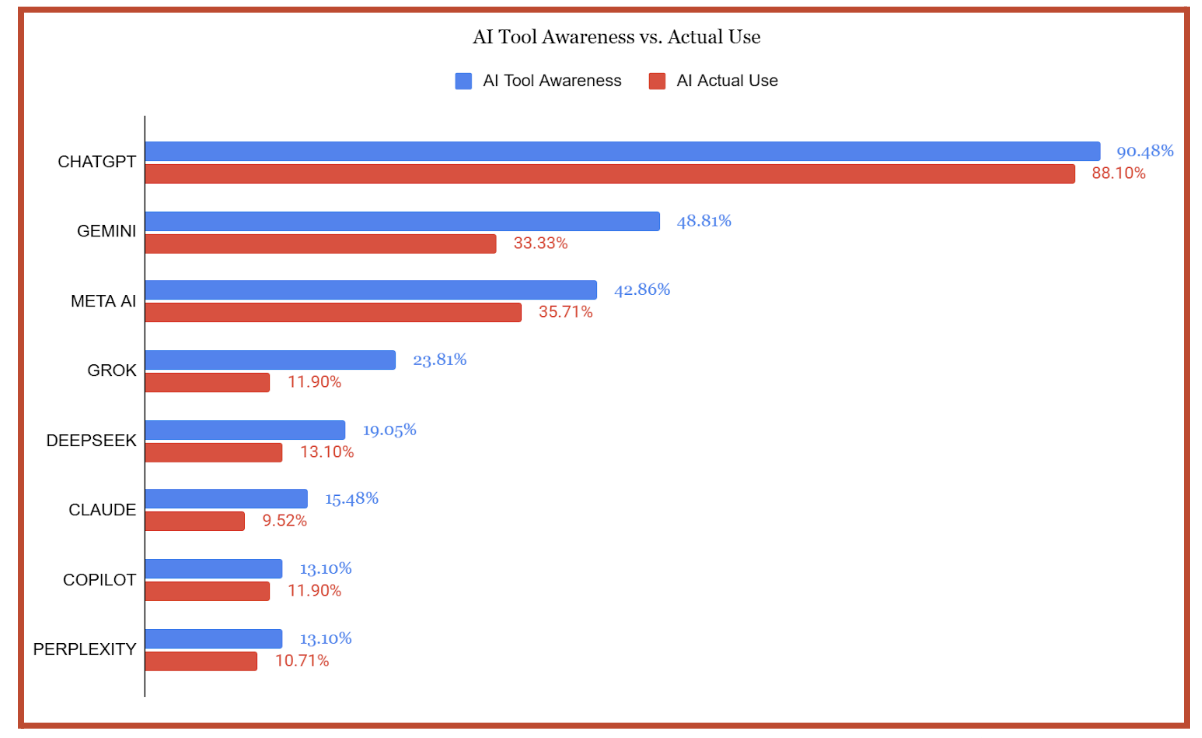
Top 8 AI Tools Among Respondents: Awareness vs. Actual Use
ChatGPT leads the list with an impressive 90.48% awareness and 88.10% usage rate, confirming its dominant presence. It is followed by Google’s Gemini (48.81% awareness, 33.33% use) and Meta AI (42.86% awareness, 35.71% use), both showing strong engagement levels. xAI’s Grok ranked fourth with 23.81% awareness, though only 11.90% reported using it. The next four—DeepSeek, Claude, Copilot, and Perplexity—each had awareness levels between 13% and 19%, but considerably lower usage rates, with none exceeding 13%.
Many of the tools mentioned (e.g. ChatGPT, Gemini, Grok, Claude and Deepseek) are generative AI chatbots that provide answers to users’ questions and prompts. And for this blog, we want to expose our readers to more specialized uses of AI.
3.0 Beyond ChatGPT
Google Cloud defines AI as “a field of science concerned with building computers and machines that can reason, learn, and act in such a way that would normally require human intelligence or that involves data whose scale exceeds what humans can analyze.” The field of AI encompasses several disciplines, including computer science, data analytics and statistics, hardware and software engineering, linguistics, neuroscience, and even philosophy and psychology. The use of AI also spans several fields. We present a few examples of how AI can be used in the fields of education, language learning, medicine and agriculture.
3.1 Education: Shule Direct & Teacher Kidevu
In the first quarter of the year, Lead For Ghana, in partnership with Shule Direct (Tanzania) and eBASE Africa (Cameroon) and with funding from the Bill & Melinda Gates Foundation, piloted the AI Teachers: Improving Teachers’ Competencies through an AI Driven Assessment Program in Ghana and Tanzania.
The aim of the project was to advance numeracy education in both countries with AI-driven assessment tools. Participating students had the chance to use the Shule Direct Kids app for assessment, while teachers had real-time insights and targeted resources based on individual student data from the app usage. This app is one of many education-based platforms that integrate AI to improve the learning and teaching experience for both students and teachers and contribute to improving student learning outcomes.
3.2 Language Learning: Khaya AI
Ghana Natural Language Processing (Ghana NLP), an open-source initiative that focuses on Natural Language Processing (NLP) of Ghanaian languages, developed Khaya AI, a language translation app for Ghanaian languages.The Khaya app uses machine learning and AI for language processing and translation. Currently, the app is able to translate from English to some Ghanaian languages (including Twi, Ewe, Ga, Fante, Dagbani, Kusaal and Gurene), Nigerian languages (including Yoruba), and Kenyan languages (including Kimeru, Luo and Kikuyu).
NATURAL LANGUAGE PROCESSING (NLP)
NLP is a subfield of computer science and artificial intelligence (AI) that uses machine learning to enable computers to understand and communicate with human language. (Source)
3.3 Healthcare: minoHealth AI labs
minoHealth AI labs is developing AI systems for radiology, infectious diseases and for biomedical research. Currently under development, minoChat is a multimodal large language model that will be trained for the interpretation of medical images. minoChat aims to be an “AI super-radiologist that can support all clinicians around the world.” In the field of infectious diseases, minoHealth is working with Makerere University to create datasets and machine learning models for the automated detection of malaria using microscopic blood tests (thick and thin smear slides).
3.4 AI in Agriculture
Artificial Intelligence (AI) is playing a crucial role in modern agriculture by improving efficiency, sustainability, and productivity.
Nuru is a smartphone app developed by PlantVillage and Penn State University and used in India, Kenya and Tanzania. The app is powered by offline image recognition AI that assists farmers in diagnosing diseases in crops like cassava and maize. The AI model also uses Food and Agriculture Organization’s water productivity database, WaPOR, to help farmers to monitor biomass on a plot of land, giving the farmers insight into how their crops are developing and assisting in deciding the best course of action for the best outcome in terms of yield (FAO, n.d.). Finally, the model has GenAi capabilities to provide automated responses to questions from farmers.
4.0 Risks and Responsible Integration of AI in Learning
Despite its potential to improve human activities and productivity, the use of AI is not without its pitfalls. In an MIT study to assess “the cognitive cost of using a large language model (LLM) in the educational context”, researchers put students into three groups and asked them to write essays using OpenAI’s ChatGPT (LLM group), Google’s search engine (Search Engine group), and nothing at all (Brain-only group). Students in the Brain-only group showed the highest brain engagement, followed by the Search Engine group, and then the LLM group (Kosmyna et al., 2025).
The above study is not an outlier when discussing the negative impact of the incorrect use of AI on the learning experience for students. Robert, Potter & Frank (2024) reports that the overreliance and dependence on AI tools in learning results in “passive learning experience” for students. Bastani, et al (2025) also reports that students are oftentimes not aware of how these AI tools impede their learning experience. And when AI tools provide students with unreliable information, students may be unable to identify the unreliable information or unwilling to verify it (Bastani, et al, 2025). Abbas, Jam, & Khan (2024) also report that the use of ChatGPT was likely to develop tendencies for procrastination and memory loss and dampen the students’ academic performance.
Despite the harms associated with using AI in the teaching and learning experience, there is still hope that AI, when used properly, can improve the experience for both students and teachers. In the aforementioned MIT study, students in the Brain-only group performed better when asked to refine their original writing with the support of ChatGPT—even better than writing without any technological support. This finding suggests that “AI-supported re-engagement invoked high levels of cognitive integration, memory reactivation, and top-down control” (Kosmyna et al., 2025), and reinforces the idea that with the appropriate support and guidance, students can use AI to enhance their learning. Overall, AI should be viewed as a tool to support educators and teachers, rather than a replacement for teachers. Schools and educators should make intentional efforts to support and guide students in the use of AI to support their learning.
5.0 Conclusion
These insights help us understand the current landscape of AI tool adoption among Ghanaian youth and inform our work at Lead For Ghana to promote digital literacy and empower young people with relevant 21st-century skills. AI usage is becoming widespread, and like all digital tools and technological advancements, there should be efforts to train people to use those tools in a way that enhances human capabilities, rather than hampering our abilities to hone our own skills. This is especially important because unlike other digital tools, young people are unable to tell when these tools are providing the wrong information, and AI is being advertised as one that is infallible (Bastani, et al, 2025). With the right training, we can use AI and other digital tools to improve learning and teaching, and worker efficiency/productivity
6.0 References
Abbas, M., Jam, F. A., & Khan, T. I. (2024). Is it harmful or helpful? Examining the causes and consequences of generative AI usage among university students. International Journal of Educational Technology in Higher Education, 21(1), 10.
Bastani, H., Bastani, O., Sungu, A., Ge, H., Kabakcı, Ö., & Mariman, R. (2025). Generative AI without guardrails can harm learning: Evidence from high school mathematics. Proceedings of the National Academy of Sciences, 122(26), e2422633122.
Food and Agriculture Organization (FAO) (n.d.). WaPOR, remote sensing for water productivity. - PlantVillage Nuru. Retrieved from https://www.fao.org/in-action/remote-sensing-for-water-productivity/applications-and-uses/applications-catalogue/product-detail/PlantVillage-Nuru/en on August 4, 2025.
Kosmyna, N., Hauptmann, E., Yuan, Y. T., Situ, J., Liao, X. H., Beresnitzky, A. V., ... & Maes, P. (2025). Your brain on ChatGPT: Accumulation of cognitive debt when using an AI assistant for essay writing tasks. arXiv preprint arXiv:2506.08872.
Robert, A., Potter, K., & Frank, L. (2024). The impact of artificial intelligence on students' learning experience. Wiley Interdisciplinary Reviews: Computational Statistics, 2(01).