

AI Teachers Pilot Program: A Follow-up
1.0 Introduction
Six months ago, Lead For Ghana embarked on a bold journey: to explore whether artificial intelligence, once considered a futuristic luxury, could meaningfully strengthen teaching practices in some of Ghana’s most underserved classrooms. Through the AI Teachers: Improving Teachers’ Competencies through an AI Assessment pilot program, teachers in nine public basic schools were introduced to an AI-powered assessment platform designed to transform instructional delivery, deepen learner engagement, and enhance foundational numeracy outcomes. The immediate results were inspiring. Teachers who once relied solely on traditional methods began integrating AI tools into their daily practice. Confidence levels soared, lesson delivery improved, and classrooms that previously struggled with engagement experienced renewed energy and curiosity. For many teachers, this intervention wasn’t just training—it was a mindset shift.
During the original pilot program, each participating teacher received two tablets equipped with the AI-powered assessment app, enabling them to bring technology directly into their classrooms. With these tablets, students engaged independently with interactive numeracy exercises while teachers received instant, individualized feedback on learner performance. This real-time insight empowered teachers to identify struggling learners quickly, tailor lessons to specific needs, and deliver more targeted support than before. For many educators in the pilot program, the tablets became an indispensable instructional companion—making teaching more data-driven, efficient, and responsive.
Unfortunately, sustaining change in education is often far more challenging than sparking it. The pilot program lasted only a few months. And suddenly, the teachers who had grown accustomed to AI-supported instruction found themselves navigating familiar challenges without the digital tools that had transformed their practice. This transition raised critical questions: Will teachers continue using digital and AI tools in their instructional practice? Did teachers’ confidence and attitudes toward technology remain strong? What barriers threatened long-term adoption—and what factors helped sustain progress? And most importantly, what can we learn to better support educators as they navigate the intersection of teaching and technology?
To answer these questions, Lead For Ghana conducted a follow-up evaluation six months after the intervention. This edition of Monthly Insights invites readers to take a thoughtful journey into the realities of sustaining innovation in Ghanaian classrooms. It uncovers powerful stories of resilience, honest reflections from teachers, and emerging lessons that will shape the next chapter of technology-enhanced learning in our schools. What happens when the pilot ends—but the learning continues? Let’s find out.
2.0 Findings
2.1 Current digital tools and platform usage in teaching
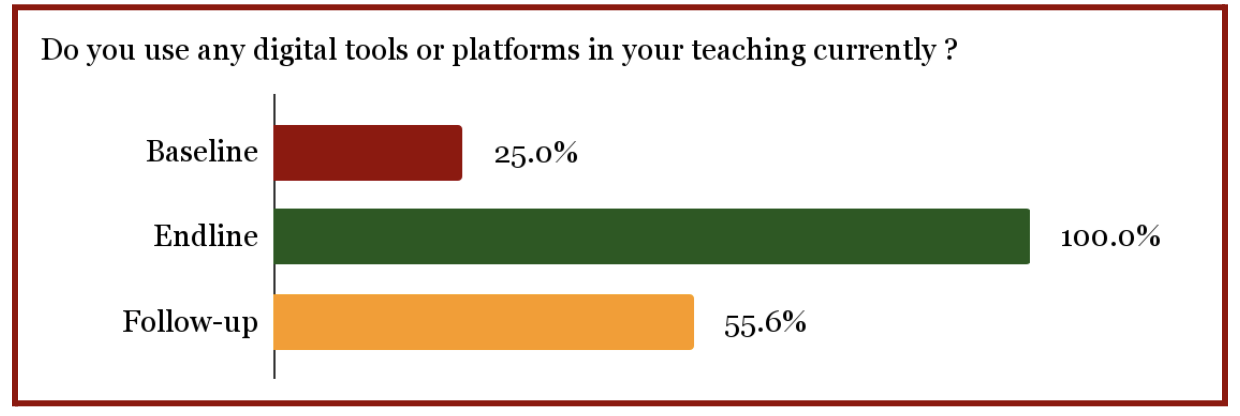
At the end of the intervention, all teachers (100%) reported using digital tools in their teaching. This was expected, as the intervention provided tablets, internet data, and continuous support, making it easy for teachers to integrate technology into their instruction. Six months after the intervention ended and after the tablets and data support were withdrawn, digital tool usage dropped to 55.6%, largely due to the absence of devices and school-level infrastructure. However, this proportion was still higher than the proportion that reported using digital tools at baseline (25.0%). The fact that more than half of the teachers continued to use digital tools on their own shows that some level of digital practice persisted even without external support. This suggests that while resource withdrawal limited full adoption, the intervention still contributed to a shift in how many teachers view and use technology in their teaching with a portion of teachers able to sustain some level of digital integration using their personal devices or alternative tools.
2.2 Teachers' opinion on how the AI-powered platform improved teaching and the students' learning
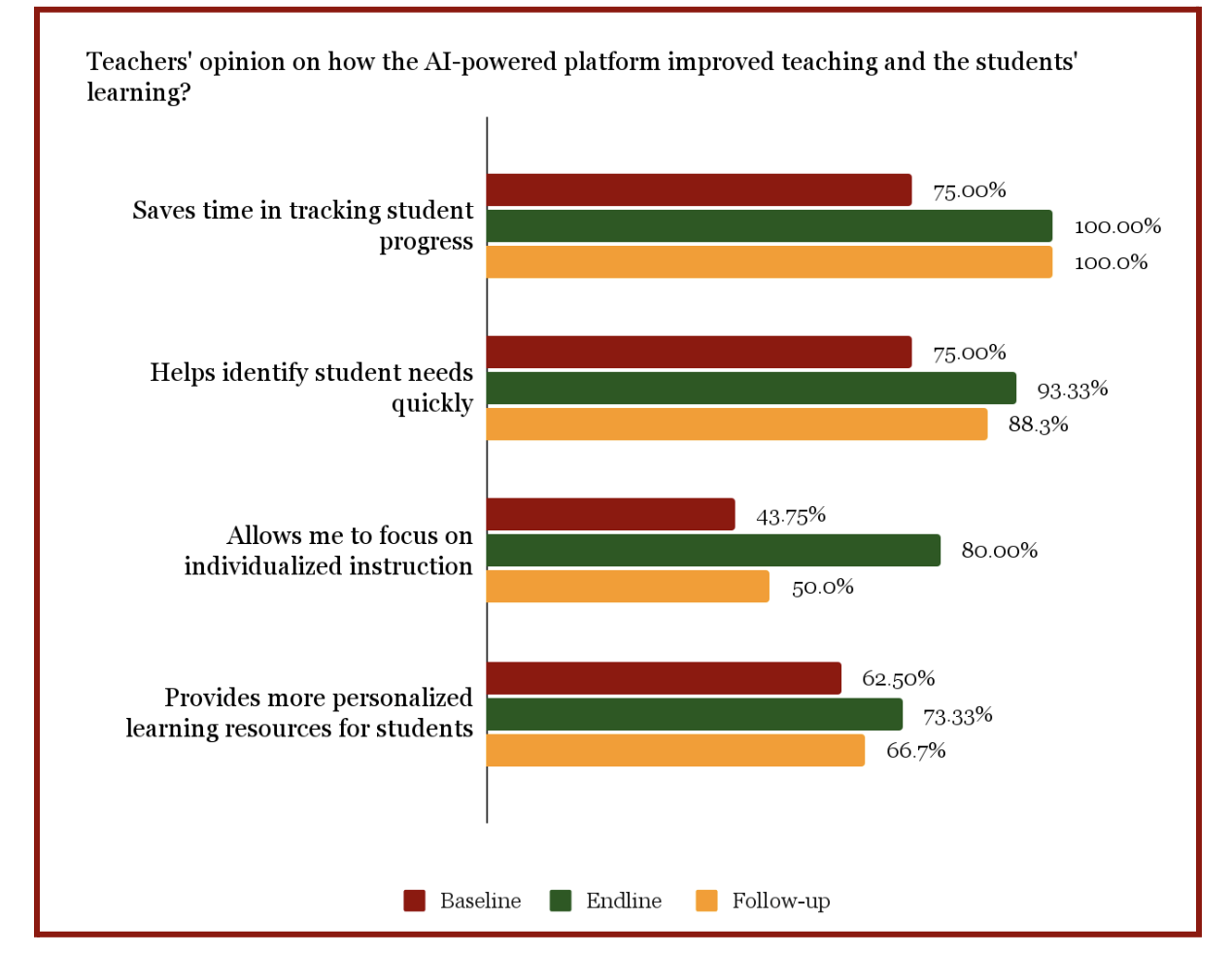
Teachers’ perceptions of the AI-powered platform remained largely positive six months after the intervention. Although some effects reduced once the platform and devices were no longer available, perceptions were still better compared to the baseline. At endline, teachers strongly agreed that the platform saved time in tracking student progress, helped identify learning needs quickly, and supported individualized instruction. These views were shaped by their active use of the platform and access to real-time learner data. At follow-up, perceptions remained largely consistent for the two strongest benefits: all teachers (100%) continued to agree that the platform saved time in tracking student progress, and 88.3% still believed it helped them identify student needs quickly. These results suggest that the experience of using the platform left a lasting impression on how teachers think about efficient assessment and learner diagnosis.
However, perceptions related to individualized instruction and personalized learning resources declined. Teachers who felt the platform allowed them to focus on individualized instruction decreased from 80% at the endline to 50% at follow-up, and those who believed it provided personalized learning resources declined from 73.3% to 66.7%. These reductions are expected, as teachers no longer had access to the platform’s adaptive features and could not rely on the automated suggestions that previously supported them. Notably, while some benefits diminished without active platform use by the intervention, teachers retained a strong appreciation for the platform’s ability to simplify assessment and highlight learner needs. This indicates that the intervention influenced how teachers understand the role of technology in improving instructional efficiency, even after the tools were withdrawn.
2.3 Teachers concerns about the use of AI powered platforms in the classroom
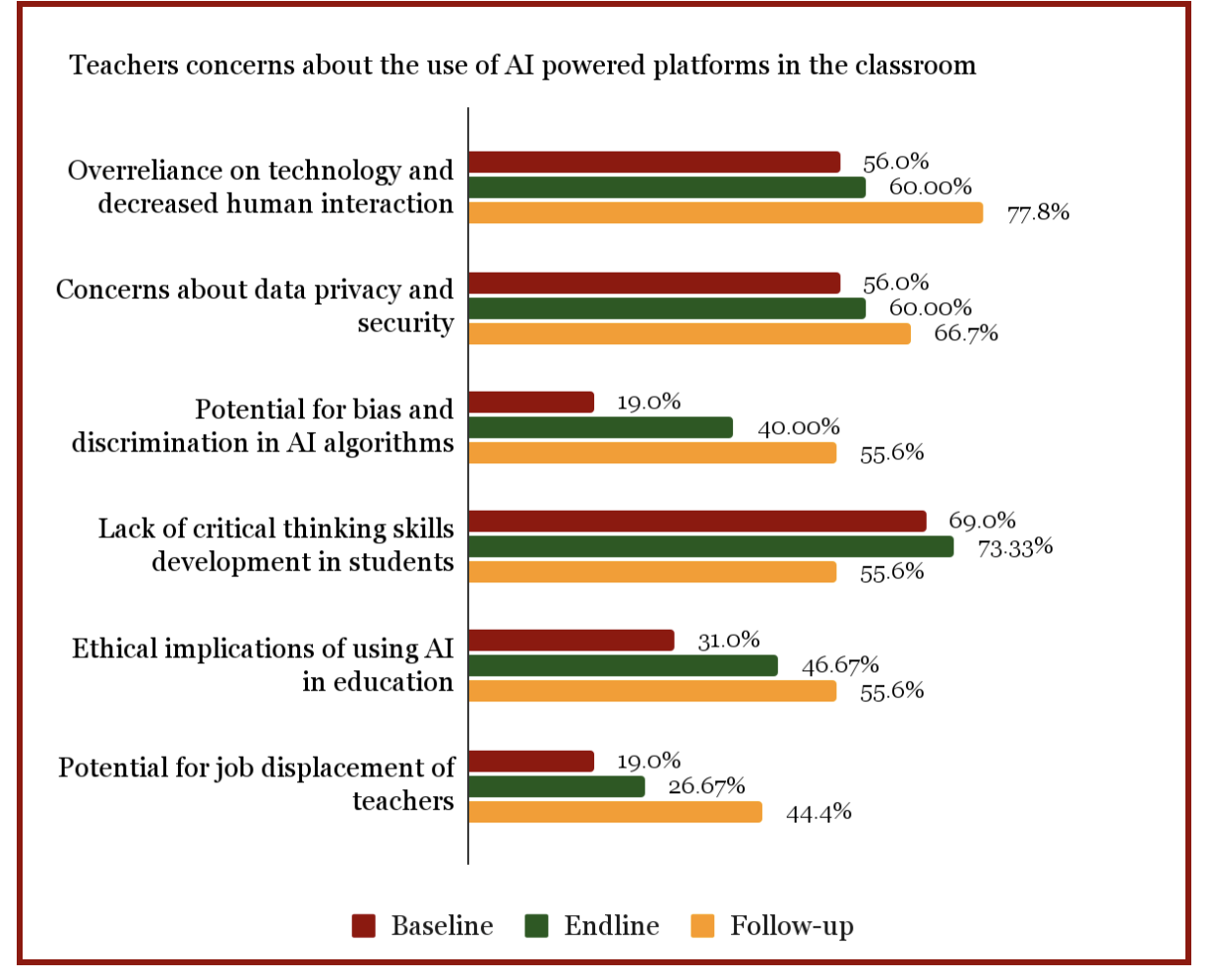
To discuss teachers’ concerns about AI, it’ll be helpful to explore how these concerns changed from baseline, through endline and at the follow-up. At baseline, concerns were present but generally moderate, as many teachers had limited exposure to AI in teaching and were still forming their opinions. At the endline and at the six-month follow-up, these concerns became more pronounced, indicating that teachers were thinking more critically about the broader implications of using AI in their classrooms.
The most notable increase was in the fear of overreliance on technology and reduced human interaction, which rose from 56% at the baseline to 60% at the endline and then to 77.8% at follow-up. Concerns about data privacy and security also increased from 56% at the baseline to 60% at the endline and then to 66.7% the follow-up, reflecting teachers’ heightened sensitivity to how student information is collected and managed. Worries about bias in AI algorithms and ethical implications of AI use rose sharply from relatively low levels at baseline (19% and 31%) to 40% and 46.67% respectively at the endline and to 55.6% at follow-up. Uncertainty about the potential for AI to limit critical thinking among students also remained high between baseline (69%) and endline (73.3%), but decreased slightly to 55.6% at follow-up. This slight reduction may indicate that teachers recognized some instructional benefits of the platform during implementation after they no longer had access to it. Finally, concerns about job displacement increased from 19% to 44.4%, showing that a significant number of teachers were considering the long-term implications of AI on the teaching profession.
Overall, the comparison shows that as teachers gained more exposure to AI and reflected on its role after the intervention, their concerns expanded beyond technical issues to include ethical, professional, and pedagogical considerations. This highlights the importance of continuous dialogue and guidance on responsible AI integration in education.
2.4 Challenges or barriers do you experience when using the AI platform
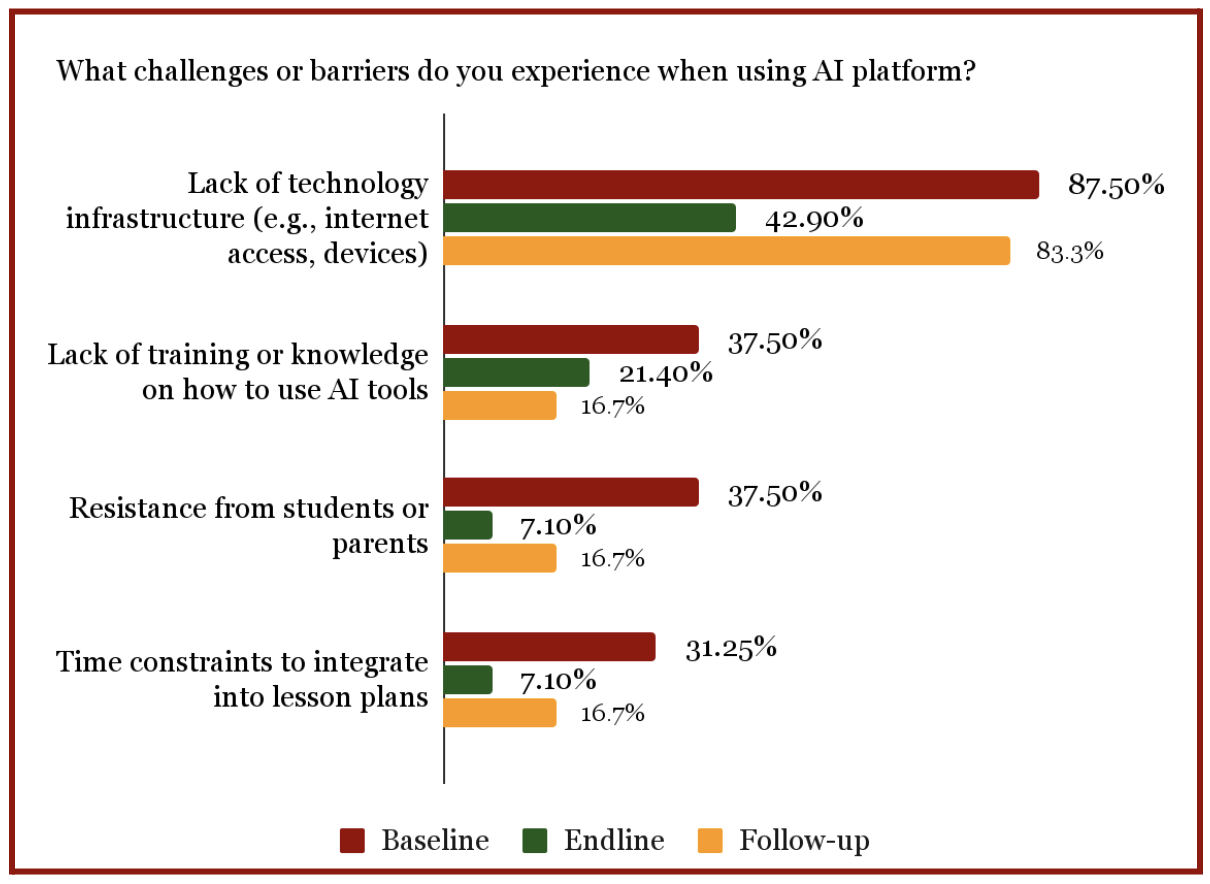
The challenges teachers faced in using the AI platform increased noticeably six months after the intervention ended, largely due to the withdrawal of project resources. The percentage of teachers who saw the lack of technology infrastructure decreased from 87.50% at baseline to 42.90% at endline. By the follow-up, this challenge had intensified significantly (83.3%), almost to the pre-intervention level, reflecting the impact of losing the tablets and data support that previously enabled smooth platform use. The percentage of teachers citing other challenges also increased once the program ended, although none to the baseline levels. Resistance from students or parents and time constraints, both reported by only 7.1% of teachers at the endline, each rose to 16.7% at follow-up. These increases suggest that without ongoing support and structured integration, teachers found it more difficult to consistently embed the platform into their lesson routines and manage broader classroom or community expectations. Interestingly, the proportion of teachers citing lack of training or knowledge decreased slightly from 21.4% to 16.7%. This indicates that the initial training provided during the intervention had a lasting effect, and teachers felt more confident in their skills even when actual platform use became limited.
These findings show that while teachers retained the knowledge needed to use the platform, their ability to do so was strongly constrained by the withdrawal of devices, internet access, and institutional support. The predominance of infrastructure-related challenges at follow-up underscores how essential these resources are for sustaining AI-driven instruction in classrooms.
3.0 Conclusion and recommendations
3.1 Conclusion
The follow-up carried out six months after the AI Teachers intervention shows that while access to devices and connectivity declined sharply after the program ended, several aspects of the intervention continued to influence teachers’ behaviour and attitudes. A little over half of the teachers still use some form of digital tools in their teaching, and two-thirds continue to engage with AI-powered platforms on their own. Although both figures represent reductions from endline levels, they indicate that parts of the digital and AI practices introduced during the intervention persisted even without project resources.
Teachers also retained a positive view of the core instructional benefits of the AI platform. They consistently recalled its value in saving time, helping them identify learner needs quickly, and making assessment more efficient. However, benefits that depended on active access to the platform—such as support for individualized instruction and personalized learning—reduced after the devices and internet support were withdrawn.
At the same time, teachers’ concerns about AI became more pronounced. Issues such as overreliance on technology, data privacy, bias, and ethical considerations featured more strongly during the follow-up. These growing concerns, together with increased challenges related to infrastructure, show that while teachers are willing to use AI and recognize its benefits, their ability to sustain these practices is limited by the absence of devices, connectivity, and ongoing support.
Overall, the findings suggest that the intervention contributed to a shift in how teachers understand and value technology in teaching, but long-term adoption remains tied to the availability of basic infrastructure and consistent support systems. Without these conditions, teachers’ motivation alone is not enough to maintain full integration of AI in classroom practice.
3.2 Recommendations
Strengthen Infrastructure and Provide Device Support: Given that 83.3% of teachers cited lack of devices and internet as a major barrier, ensuring consistent access to tablets, smartphones, and reliable connectivity is critical. Schools need dedicated digital devices, stable internet, and basic ICT infrastructure to enable continuous use of AI-powered tools.
Provide Continuous Training and Technical Support: Although teachers showed strong motivation, 16.7% still reported training gaps, and 83.3% requested ongoing support. Regular refresher sessions, coaching, and troubleshooting assistance will help teachers deepen their skills and sustain confidence in using digital and AI tools effectively.
Develop Curriculum-Aligned and Localized Digital Content: With 66.7% of teachers identifying lack of relevant local content as a challenge, future AI platforms should incorporate materials aligned with the Ghanaian curriculum and contextualized examples that match learners’ realities. This will make AI tools more practical for daily lesson delivery.
Build Teacher Collaboration Networks and Professional Communities: Since 83.3% of teachers requested collaboration opportunities, establishing communities of practice can strengthen peer learning, enable teachers to share strategies, and make implementation more consistent across schools. Peer-to-peer support can also help address concerns and improve adoption.