Power of Youth Co-Creating Education
1.0 Introduction
Across the world, young people continue to play increasingly visible roles in shaping social change. In education, however, youth are still often positioned as passive recipients of decisions made by adults, rather than as active contributors to the systems that affect their learning and futures.
The 2026 International Day of Education, themed “The power of youth in co-creating education,” recognizes young people as agents of change in achieving inclusive and equitable quality education and in building peaceful, just, and inclusive societies. The theme calls for a shift from viewing youth as beneficiaries of education reform to recognizing them as partners in designing, improving, and sustaining education systems.
In response to this call, Lead For Ghana sought to understand how the general public perceives the role of youth in co-creating education. At the same time, the organization reflected on how young people within our ecosystem are already translating these ideas into practice within Ghana’s education system. This month’s insight therefore brings together public perspectives and youth-led action, exploring what co-creating education looks like in principle and how it is being realized in practice.
2.0 Public Perspectives on Youth Co-Creating Education
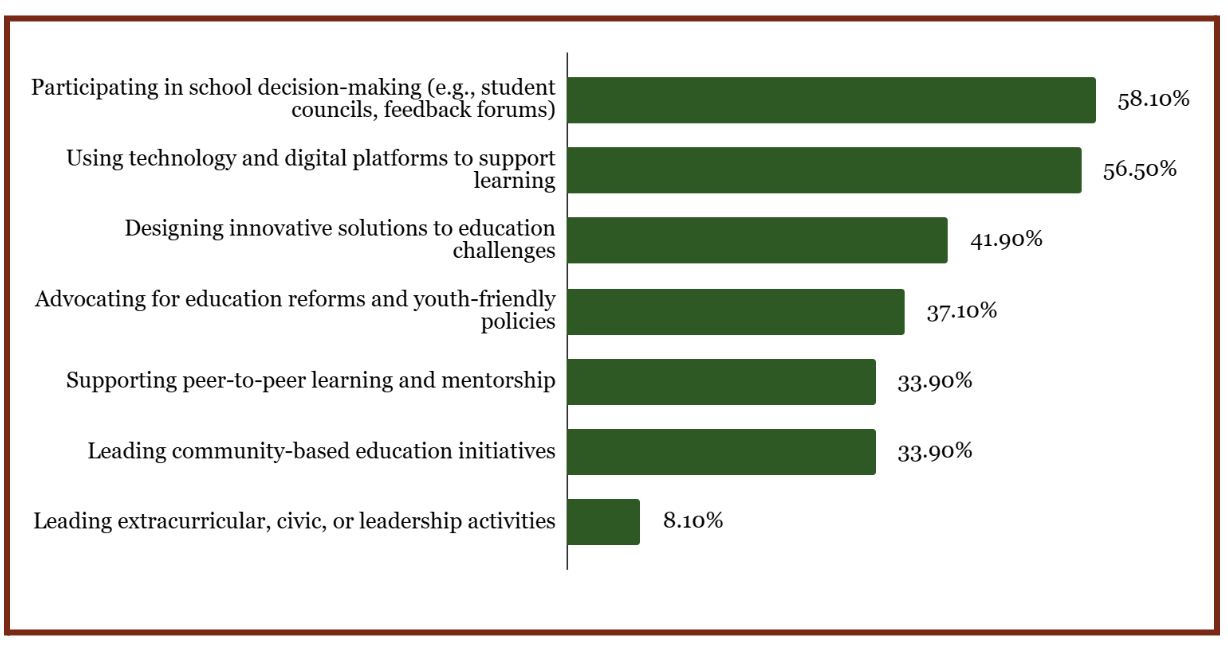
To explore public understanding of youth participation in education, Lead For Ghana conducted an online survey targeting young people and members of the general public. Respondents were asked to identify the key ways in which they believe youth can actively co-create education in schools, communities, and society at large. Participants selected their top three options, allowing the study to capture priority areas where youth involvement is seen as most impactful.
The public perspectives outlined above paint a clear picture of what co-creating education is expected to look like. While these ideas are often discussed in theory, young people within the Lead For Ghana ecosystem are already putting many of them into practice.
Participation in school decision-making (58.10%): The most frequently selected option was participating in school decision-making, cited by 58.10% of respondents. This includes involvement through student councils, feedback forums, and other platforms that allow young people to contribute to decisions that affect teaching, learning, and school culture. This finding suggests that the public strongly associates co-creation with having a voice. Youth are not seen merely as recipients of educational policies and practices, but as stakeholders whose perspectives can shape school governance and improvement processes. The prominence of this option highlights a growing recognition that inclusive decision-making can lead to more responsive and relevant education systems.
Using technology and digital platforms to support learning (56.50%): Closely following was the use of technology and digital platforms to support learning, selected by 56.50% of respondents. This reflects an understanding of youth as digital actors who can leverage technology to enhance access, engagement, and innovation in education. The high ranking of this option suggests that the public views digital tools as spaces where young people can actively contribute to education, whether by creating content, facilitating online learning, or introducing new ways of sharing knowledge. Technology is therefore seen as a key pathway through which youth can co-create learning experiences that are adaptable to contemporary needs.
Designing innovative solutions to education challenges (41.90%): About 41.90% of respondents identified designing innovative solutions to education challenges as a key way youth can co-create education. This points to an expectation that young people can contribute beyond participation and into problem-solving and innovation. This finding positions youth as contributors of ideas and solutions, capable of identifying gaps within education systems and proposing creative responses. While fewer respondents selected this option compared to decision-making and technology use, its relatively strong showing suggests that innovation is increasingly associated with youth agency in education reform.
Advocating for education reforms and youth-friendly policies (37.10%): Advocacy for education reforms and youth-friendly policies was selected by 37.10% of participants. This highlights a perception of youth as actors who can influence education beyond the classroom, engaging with broader policy and governance processes. The result reflects moderate but meaningful public support for youth involvement in shaping education policy. It suggests that while advocacy is recognized as important, it may still be seen as less immediate or accessible for the youth, when compared to school-level participation and technological engagement.
Supporting peer-to-peer learning and mentorship (33.90%): Exactly 33.90% of respondents identified supporting peer-to-peer learning and mentorship as a way youth can co-create education. This underscores the value placed on youth supporting one another’s learning and development through shared experiences and guidance. Although not among the top two priorities, this finding reflects an appreciation of informal and relational approaches to learning, where young people act as mentors, facilitators, and role models within their communities and institutions.
Leading community-based education initiatives (33.90%): About 33.90% of respondents identified leading community-based education initiatives as a way young people can actively co-create education. This highlights a public recognition that youth engagement in education is not limited to formal school settings, but can also take place within communities where learning needs are often most visible. This response suggests that respondents see value in youth-led efforts such as community learning programs, outreach initiatives, and locally driven education projects that respond to specific social and educational challenges. Through these initiatives, young people can contribute by identifying gaps in access, supporting learning outside the classroom, and working with local stakeholders to strengthen educational opportunities. Finally, although this option ranked below school-based decision-making and technology-driven approaches, its selection by roughly one-third of respondents indicates that community-level action is viewed as a meaningful complement to formal education systems, rather than a replacement for them.
Leading extracurricular, civic, or leadership activities (8.10%): The least selected option was leading extracurricular, civic, or leadership activities, chosen by 8.10% of respondents. This comparatively low percentage suggests that these activities are less strongly associated with the idea of co-creating education. While extracurricular and civic engagements remain important for youth development, the public appears to distinguish them from direct influence on education systems. This may indicate a perception that such activities, although valuable, have a more indirect impact on educational outcomes compared to decision-making, innovation, and learning processes.
3.0 From Public Perception to Practice: Youth Co-Creation Within Lead For Ghana
Lead For Ghana works directly with young people to strengthen education systems by developing leadership, placing youth in classrooms and communities, and supporting long-term pathways for impact. Within this ecosystem, youth are not only implementing solutions but also shaping how education is delivered, experienced, and sustained. The sections that follow highlight how Associates and alumni are actively co-creating education in ways that closely align with public expectations.
Building on these insights, this section explores how Lead For Ghana alumni are living out this vision after completing the Lead For Ghana Youth Leadership Development Fellowship, which mandates serving as a full-time teacher in a high need school, with a focus on the impact of three alumni: Saraswati Arthur (2017), Abdul Rahman (2021) and Ruhiya Suguru Aguri (2023). Through their current roles and initiatives, these alumni continue to apply the leadership skills, classroom exposure, and values developed during the Fellowship to co-create education across classrooms, communities, and policy spaces. The stories that follow illustrate how the Fellowship experience extends beyond placement years, translating into sustained and practical impact within Ghana’s education ecosystem.
During her Fellowship, Saraswati Arthur developed her leadership and instructional skills through mentorship from Limited Resource Teacher Training (LRTT ) and immersive classroom experience. The support and networks she accessed through Lead For Ghana enabled her to pilot literacy-focused projects that later evolved into The Reading Factory. Today, the initiative promotes foundational and inclusive literacy, including the launch of Ghana’s first Inclusive Reading and Arts Festival in 2023, with expansion to the Volta Region and continued support for schools and teachers.
Similarly, Abdul Rahman translated his Fellowship experience into systems-level impact. Exposure to learning conditions in underserved schools during his leadership development informed his advocacy approach. In his current role at Norsaac, where he manages the CHANGE Project, Nalerigu Area Child Development Program (NACDP), and Heard Everywhere, Represented Daily (HEARD) project, Abdul recently influenced a budget decision to provide furniture and learning materials to schools lacking basic amenities. This demonstrates how lived classroom realities can inform policy and resource allocation.
Also, Ruhiya Suguru Aguri extends youth co-creation of education beyond the classroom through innovation and inclusive design. She is the co-founder and project coordinator of Untamed Voices, a documentary-focused organization that uses storytelling as a tool to advance inclusive education. Under her leadership, Untamed Voices launched the Deaf and Dynamic Project, a platform designed to equip deaf and hard-of-hearing youth with employability skills. Implemented in collaboration with the Google AI Center and other partners, the initiative explores how AI and digital storytelling can bridge communication gaps and expand economic opportunities for young people with hearing impairments. Ruhiya and her team are also developing an AI-powered application that translates sign language into text or speech and vice versa, with the potential to significantly improve accessibility in education and public spaces in Ghana. Building on the leadership foundation developed through Lead For Ghana, Ruhiya continues to deepen her impact; demonstrating how youth leadership can drive innovation, inclusion, and system-level change within education.
These alumni stories reflect a shared outcome of the Lead For Ghana Fellowship: young leaders applying their experiences, skills, and values to co-create education through classrooms, communities, and systems long after the Fellowship ends.
4.0 Key reflections
The findings from the public perspectives and the alumni experiences presented in this insight point to several important reflections on youth co-creating education in Ghana.
First, there is strong alignment between public expectations and lived practice within the Lead For Ghana ecosystem. The public identified youth participation in decision-making, innovation, advocacy, and community-based initiatives as key pathways for co-creating education. The alumni examples illustrate how these pathways are already being activated through literacy initiatives, policy advocacy, and improvements to school learning environments. This demonstrates that youth-led education change is not aspirational, but already underway.
Second, exposure to classroom realities plays a critical role in shaping long-term leadership and impact. Across the alumni stories, firsthand experience with under-resourced learning environments during the Fellowship informed how alumni now engage with education in their professional roles. Whether through designing literacy programs, influencing budget decisions, or mobilising resources for schools, these experiences continue to shape how alumni identify gaps and respond to them beyond their placement years.
Third, the insights highlight that co-creating education extends beyond formal teaching roles. While some alumni continue to work directly in education delivery, others operate at community or systems levels, influencing policy, resource allocation, and program design. This reinforces the public perspective that youth contributions to education are multidimensional and not limited to the classroom alone.
Finally, the findings suggest that leadership development is a key enabler of sustained youth impact. The ability of alumni to translate Fellowship experiences into long-term initiatives reflects the importance of equipping young people with leadership skills, networks, and opportunities to apply learning in real-world contexts. When youth are supported in this way, their engagement with education systems continues well beyond short-term interventions.
5.0 Conclusion
This month’s insights demonstrate that youth are already co-creating education in practical and meaningful ways. Public perspectives point to the importance of youth participation, innovation, advocacy, and community action, while the alumni examples show how these ideas translate into real impact beyond the Fellowship. The experiences of Lead For Ghana alumni highlight the value of investing in youth leadership and sustained pathways for engagement. When young people are equipped with the skills, exposure, and support to address real educational challenges, their influence continues across classrooms, communities, and systems. To strengthen education outcomes in Ghana, stakeholders must intentionally create space for youth voices, support youth-led initiatives, and invest in leadership development that enables long-term impact. Co-creating education requires shared responsibility and meaningful progress depends on continued collaboration across sectors.